Knee replacement (arthroplasty) replaces damaged bone and cartilage in the knee joint with prosthetic components to relieve pain and restore function. It is one of the most commonly performed and most successful operations in orthopaedic surgery, with high patient satisfaction and durable long-term results.
Is Knee Replacement Right for Me?
Knee replacement is most appropriate for patients with advanced arthritis who have significant pain and loss of function that is no longer responding to non-surgical care. Common symptoms include pain with walking or stair climbing, stiffness that limits daily activity, and pain that interferes with sleep. Knee replacement is not appropriate for milder or occasional pain.
Nonsurgical treatment options for knee arthritis include anti-inflammatory medications (such as acetaminophen, ibuprofen, or naproxen), activity modification, physical therapy, corticosteroid injections, and viscosupplementation (gel injections).
Total Knee vs. Partial Knee (UKA)
When arthritis is confined to a single compartment of the knee, a unicompartmental knee arthroplasty (UKA), or partial knee replacement, is a better option. I actively offer UKA to patients who meet the clinical criteria, as it preserves more bone, results in a more natural-feeling knee, and is associated with faster recovery.
| Feature | Total Knee Replacement | Unicompartmental (UKA) |
|---|---|---|
| Bone removed | All three compartments resurfaced | Only the affected compartment |
| Ligaments | Anterior cruciate ligament removed | Anterior cruciate ligament preserved |
| Feel | Highly reliable; some patients notice it feels mechanical | Feels more natural |
| Recovery | Typically 3–6 months to full function | Often faster; less surgical trauma |
| Candidates | Arthritis affecting multiple compartments | Arthritis confined to one compartment with intact ligaments |
The total knee replacement prosthesis
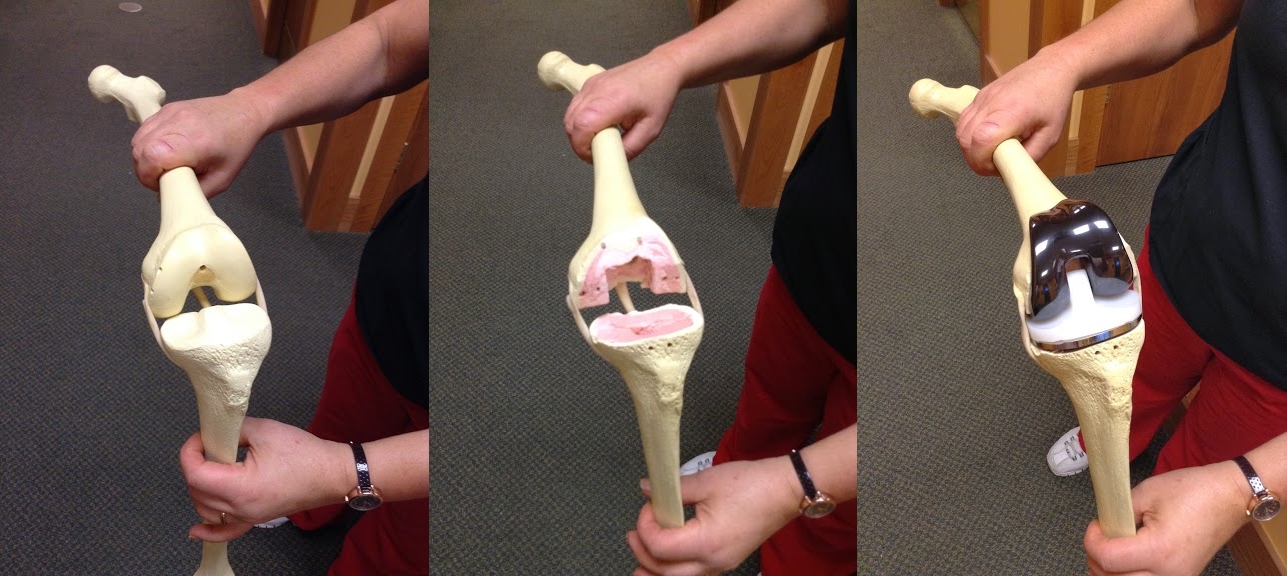
| Component | Function |
|---|---|
| Femoral Component | A metal shield that caps the end of the thigh bone. |
| Tibial Tray | A metal baseplate anchored into the shin bone. |
| Polyethylene Insert | The "plastic" bearing surface. |
How Long Does a Knee Replacement Last?
Knee replacement is among the most durable joint procedures available. Large registry studies report implant survival rates of approximately 93–97% at 10 years for total knee replacement. UKA has historically shown slightly higher revision rates, approximately 90–95% in well-selected patients.
How is robotic knee replacement different?
The MAKO robot combines data from a CT scan with live surgery data to guide a robotic saw blade during the first half of the surgery. Implantation of the prosthesis is the same.
While studies have shown equivalent outcomes between robotic and traditional knee replacement surgery, robotic surgery does allow for more methodic balancing of the ligaments during surgery. Therefore, I offer robotic MAKO surgery to all patients who request it, or when use of traditional instrumentation is not possible. A CT scan must be done before surgery in order to utilize the Mako robot.
Recovery Timeline
- Day of surgery: Surgery is typically performed under spinal anesthesia with sedation. Most patients are up and walking with assistance on the same day. Typically we aim to discharge you home the same day. We offer home care, which involves visits by a nurse and a physical therapist to your home for several weeks.
- Weeks 0-2: Physical therapy begins immediately. The priority in these first two weeks is maintaining at least a 0–90° arc of motion before scar tissue sets in. You must perform range-of-motion exercises after every meal, despite surgical pain. This 2-week window is your chance to keep your knee from becoming permanently stiff. Other than exercises to maintain range of motion, you should avoid irritating the knee in order to avoid additional pain and swelling.
- Weeks 3–6 (Avoid setbacks): Continue range of motion exercises. Transition to a cane, and then wean off. Driving is typically not permitted for the first 6 weeks.
- Weeks 6–12 (Early Function): Most patients are walking independently and returning to light daily activities. Therapy transitions to strengthening.
- Months 3–6 (Strengthening): Focused rehabilitation to restore strength, endurance, and confidence on the knee.
- Months 6–12 (Full Recovery): Final maturation. Most patients reach maximum improvement by the one-year mark.
- The Ultimate Goal: A "forgotten joint"—returning to daily life without thinking about your knee.
Outcomes of knee replacement
While total knee replacement boasts a high success rate, patient satisfaction is approximately 90%. This reflects the surgery's excellence in eliminating arthritic pain, though it also acknowledges that for some, a mechanical joint—which lacks the natural ACL—may not perfectly replicate the 'forgotten' feel of a healthy biological knee.
Understanding why this is the case requires a brief look at how the knee actually works. The human knee is not a simple hinge; it is a complex joint where the femur rotates and slides on the tibia. Because knee replacement requires the sacrifice of the Anterior Cruciate Ligament (ACL), the knee's natural motion is fundamentally altered, moving from a biological "roll-and-glide" to a mechanical hinge approximation. While knee replacement surgery is highly effective at resolving debilitating pain, the absence of the ACL means the prosthetic joint will not feel or move exactly like a healthy, natural knee.
Surgery risks
- Infection: The most serious complication, occurring in approximately 1% of cases. Treatment often requires additional surgery.
- Stiffness: Some patients develop limited range of motion despite therapy. Early and consistent rehabilitation is the most important factor in achieving the best possible outcome.
- Blood clots (DVT/PE): Blood thinners and early mobilization are used routinely to reduce this risk.
- Component loosening: Wear over time may eventually require revision surgery.
- Instability: The knee may feel unstable if soft tissue balancing is imperfect; occasionally requires further treatment.
- Nerve or vessel injury: Rare, but can affect sensation or circulation around the knee.
- Fracture: Risk of bone fracture during component insertion, particularly in patients with osteoporosis.